Meta trial, Stars and Stripes firings and streaming ads put media accountability in focus

The media business entered the week with accountability pressures on several fronts: Meta is defending its youth-safety practices in court, the Pentagon's move against Stars and Stripes has raised press-independence alarms, streaming is taking more TV ad money while prices weaken, and AI-related rights disputes are moving from publishers to creators and platforms.
Meta trial tests whether platform design can be treated as youth harm
A federal trial in Oakland has put Meta's Instagram and Facebook design choices at the center of a broader social-media accountability debate. California, Colorado, Kentucky and New Jersey, the first four of 29 states that sued Meta in 2023, allege that the company built features to keep young users engaged, collected data from children under 13 without parental consent, and hid risks from the public. AP reported that Judge Yvonne Gonzalez Rogers is overseeing a roughly six-week proceeding that could include Mark Zuckerberg and other Meta executives. Meta says it has invested in safety and disputes the states' theory; the case matters because it targets product architecture, not just individual posts.
Read the full storyFormer Meta safety executive says under-13 use was treated as an open secret
The states' case gained force when former Meta engineering director Arturo Bejar testified that Instagram had a 'don't ask, don't tell' attitude toward users under 13. He said performance reviews and compensation for user-facing product teams focused mainly on user numbers and time spent, while safety was an afterthought. He also told jurors that Meta had sophisticated systems to detect fake accounts but no goals or metrics to identify suspected underage users, and that opt-in safety tools such as 'Take a Break' were too easy to ignore. The testimony connects child-safety regulation with the media industry's core engagement model.
Read the full story
Pentagon move against Stars and Stripes raises editorial-independence concerns
The Pentagon's separation notices for Stars and Stripes publisher Max Lederer, editor-in-chief Erik Slavin and Middle East reporter Lara Korte have become a press-freedom flashpoint. CBS News reported that the notices gave Lederer and Slavin five days to appeal and cited insubordination; Slavin said the cited conduct was his statement that censorship of news for service members would be a red line. Stars and Stripes is partly taxpayer-funded but has long emphasized editorial independence, with roughly half of its $29 million annual budget coming from taxpayers and an average daily reach of 1.4 million people. The dispute links newsroom governance, public funding and military accountability.
Read the full story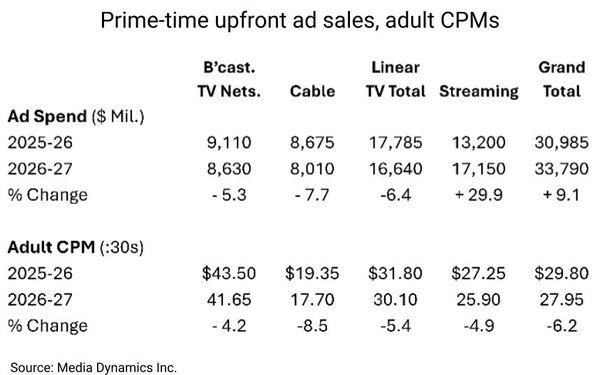
Streaming captures TV ad dollars, but inventory growth pressures pricing
The shift from linear TV to streaming is now visible in upfront ad commitments. MediaPost, citing Media Dynamics estimates, reported that total 2026-27 prime-time upfront sales rose 9% to $33.7 billion, with streaming up 30% to $17.2 billion while cable fell 7% to $8.0 billion and broadcast slipped 5% to $8.6 billion. CPMs fell across broadcast, cable and streaming, suggesting buyers are using expanded connected-TV and FAST inventory to demand lower prices. Netflix separately said its U.S. upfront ad commitments nearly doubled and highlighted live sports, programmatic buying and MRC accreditation. For media companies, more ad money is moving online, but pricing power is not guaranteed.
Read the full story
AI and measurement disputes widen from publishers to creators and ad-tech infrastructure
AI-related rights fights are now reaching both professional publishers and creator video. Bloomberg Law reported that Snap failed to dismiss YouTube creators' proposed class-action DMCA claim alleging that YouTube video scraping for AI training circumvented access protections; the ruling allows the claim to proceed and is not a final liability finding. Publishers are pressing similar economics: The Guardian reported that News Corp Australia's digital subscriptions slipped from 1.166 million to 1.162 million while CEO Robert Thomson criticized AI companies that use publisher material without permission. At the same time, measurement is consolidating: Nielsen agreed to acquire DoubleVerify for about $2.15 billion, aiming to combine audience measurement with fraud, viewability and brand-safety verification across TV, CTV, social, mobile and AI platforms.
Read the full story T
TPulled the most relevant stories from the last 24h — headlines, key points and original sources are all in.
 J
JGot it. Wrote it up in four languages across six sections, leading with why this matters right now.
 W
WFact-checked. Asked Jasper to tighten two figures and drop the AI-speak; the rest holds — ship it.
Explore the world's news with MokiNewsExplore the world's news with MokiNewsExplore the world's news with MokiNewsExplore the world's news with MokiNewsExplore the world's news with MokiNewsExplore the world's news with MokiNewsExplore the world's news with MokiNewsExplore the world's news with MokiNewsExplore the world's news with MokiNewsExplore the world's news with MokiNewsExplore the world's news with MokiNewsExplore the world's news with MokiNewsExplore the world's news with MokiNewsExplore the world's news with MokiNewsExplore the world's news with MokiNewsExplore the world's news with MokiNewsExplore the world's news with MokiNewsExplore the world's news with MokiNewsExplore the world's news with MokiNewsExplore the world's news with MokiNewsExplore the world's news with MokiNewsExplore the world's news with MokiNewsExplore the world's news with MokiNewsExplore the world's news with MokiNewsExplore the world's news with MokiNewsExplore the world's news with MokiNewsExplore the world's news with MokiNewsExplore the world's news with MokiNewsExplore the world's news with MokiNewsExplore the world's news with MokiNews